2025 — now · LIVE · Lead
Taskeen Unity
Where an organisation keeps every case it has ever held.
Delivered under Rumination Labs
- 25,000+PATIENT RECORDS IN PRODUCTION
- 110,000+FILES, COUNTING CLINICAL SUB-FILES
- 27DIMENSIONS YOU CAN CROSS-TABULATE
- RETRIEVALASSISTANT OVER TEN PROTOCOL MODULES
What it is
Unity is the system Taskeen runs its clinical practice on. It holds the beneficiary register, the sessions calendar, clinician capacity, team access, aggregate reporting, and an assistant that answers questions from the organisation’s own protocol manuals. It is in production at v4.2.0 with more than 25,000 patient records and, once clinical sub-files are counted, over 110,000 files.
A case is not a form
The mistake would have been to model a beneficiary as one record with one intake form. A case accumulates: an initial patient file, then psychologist follow-ups, psychiatric follow-ups, therapy evaluations, a psychiatric evaluation, a financial-eligibility assessment for subsidised care, and an impact-evaluation instrument. Seven kinds of sub-file, each with its own shape, all hanging off one identifier — and the register above them has to stay readable while the record underneath grows for years.
The intake, and its gates
The initial file runs to roughly thirty fields and is not a flat questionnaire. Distress sources and symptom clusters are multi-select. A risk screen sits in the middle of it — self-harm, access to means, prior attempts, risk to others, psychotic and manic presentation, substance use, family history — and each item that comes back positive asks the clinician to write it up in the case details rather than leaving a bare checkbox behind. Past services and chronic conditions gate their own follow-up fields, so the form only asks what the answers have made relevant.
Reassignment is data, not an edit
Every case carries both the psychologist who took it and the psychologist who holds it now. Continuity of care is a real reporting question for an organisation this size, and it cannot be answered if a reassignment silently overwrites the original. The register also shows who last touched each row, so the audit trail is on the surface rather than buried in a log.
Planning a clinic, not just booking it
The calendar does what calendars do — month, week, day and agenda views, per-clinician visibility, search by case ID or contact. The capacity ledger is the more useful half: it plans initial and follow-up slots as separate quantities, tracks cancellations against them, and reports utilisation per day. Initial sessions and follow-ups compete for the same clinician hours but are not interchangeable, and a helpline that cannot see that distinction cannot staff itself.
Dost — asking the protocol
Taskeen’s clinical operating knowledge lived in ten protocol manuals: programme overview and staff roles, helpline coordinator onboarding, helpline management and appointments, data management and ethics, psychotherapy and psychiatric protocols, clinical supervision, trainee protocols, monitoring and evaluation, and special cases. Dost ingests them as PDFs, vectorises them, and answers questions against them in chat, with the system prompt exposed as an editable setting. The point is not novelty — it is that a coordinator mid-call can ask what the protocol says instead of remembering which manual it was in.
Reporting without a data team
Statistics is a cross-tabulation builder rather than a fixed dashboard. Twenty-seven dimensions are reportable — demographics, symptom and diagnosis fields, and operational ones like referral source and session status — any of which can be crossed against a second field, filtered by date range, clinician or partner, and thresholded by percentage. Multi-select fields chart differently from single-value ones because they have to. It means the organisation can answer a funder’s question the day it is asked.
Access, narrowly
Sign-in is Google SSO only, restricted to the team, and the login screen says plainly that every action is logged. Roles separate super admins, psychologists and practitioners, and permissions also apply at the level of an individual case file, granted in bulk where a caseload moves. In a mental-health record, who can open a file is part of the clinical design, not an afterthought in the settings page.
Surfaces
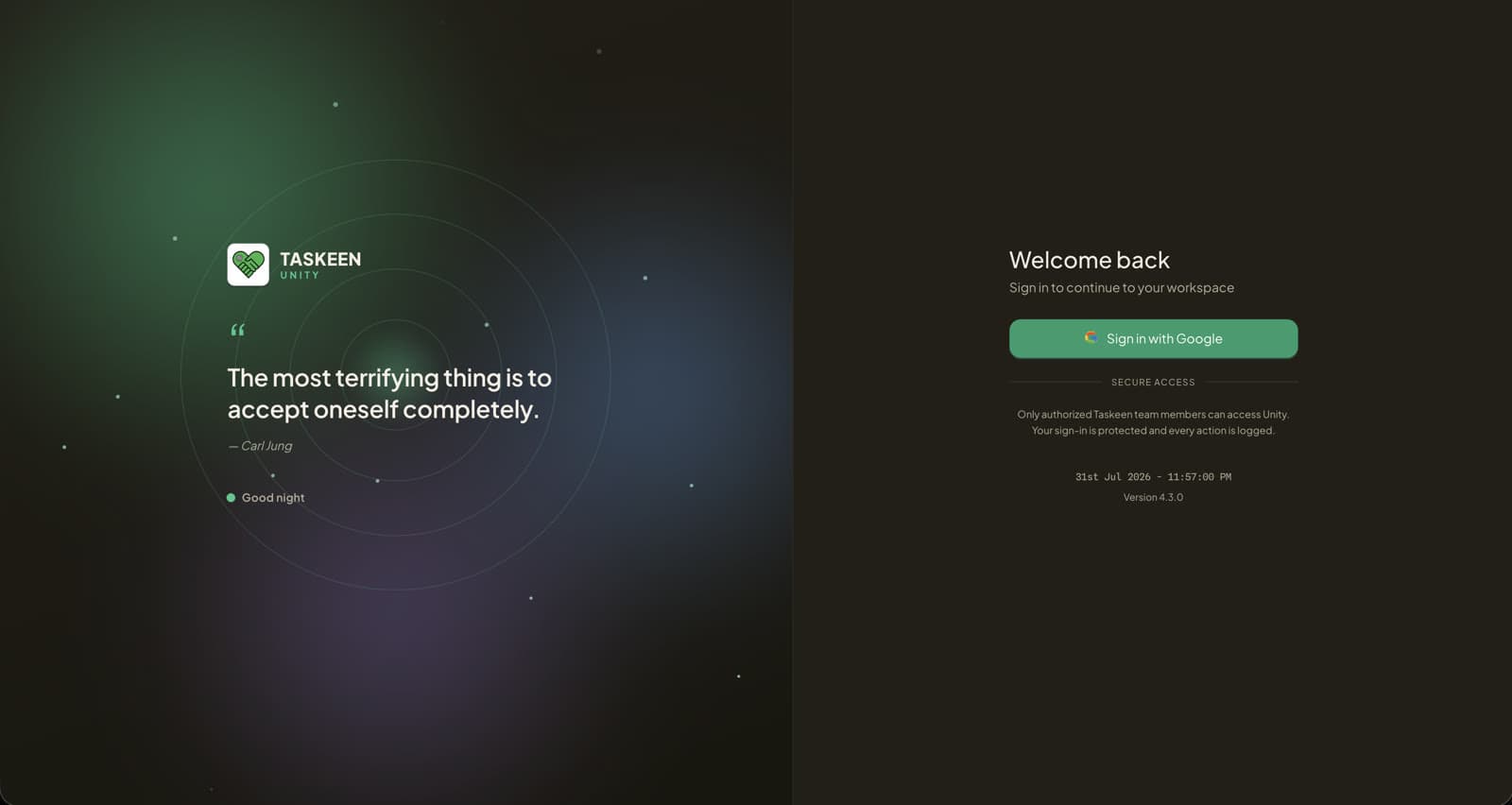
SIGN IN — THE DAY’S EPIGRAPH, THEN GOOGLE SSO 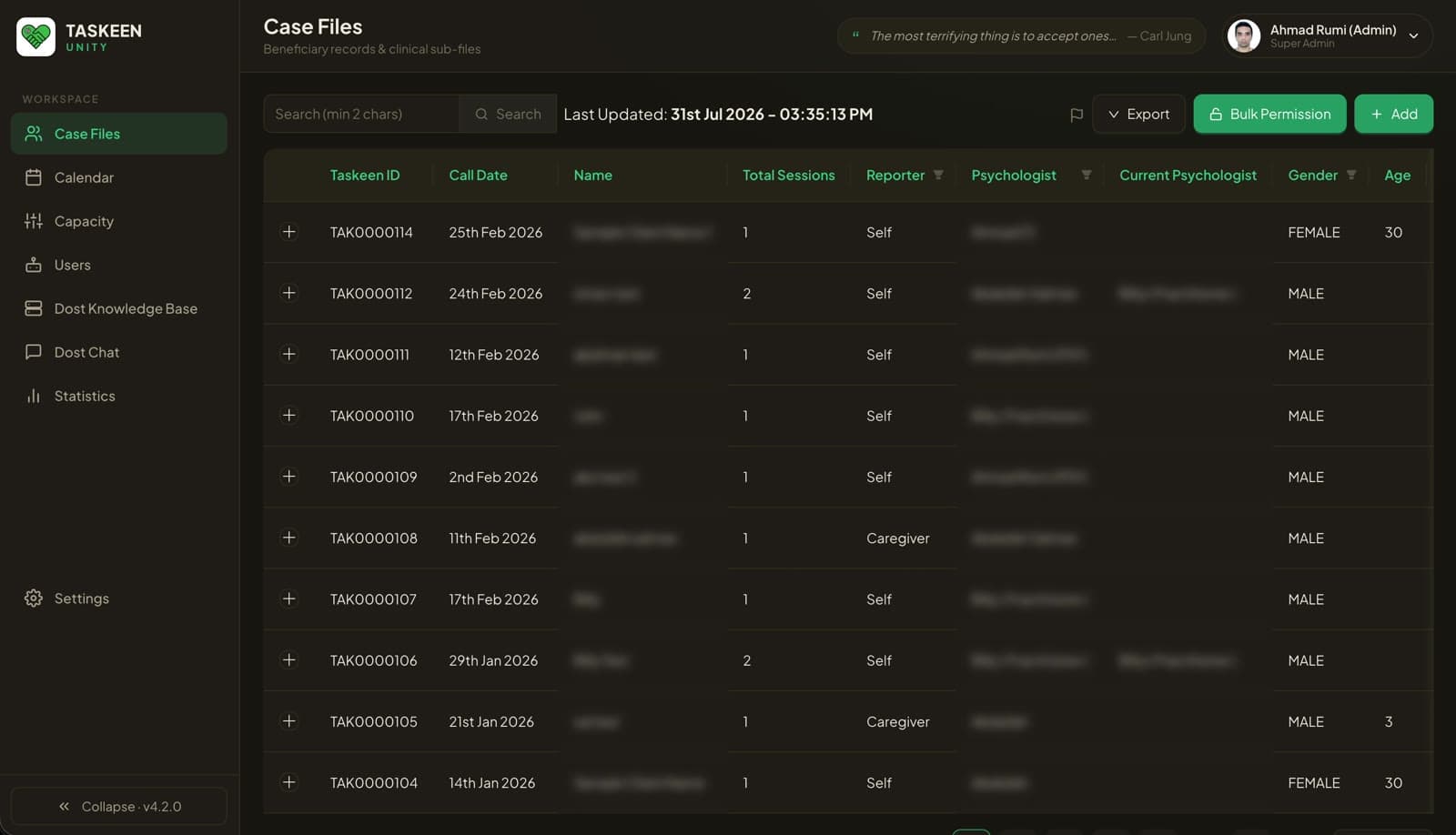
THE REGISTER — DEV ENVIRONMENT, NAMES REDACTED 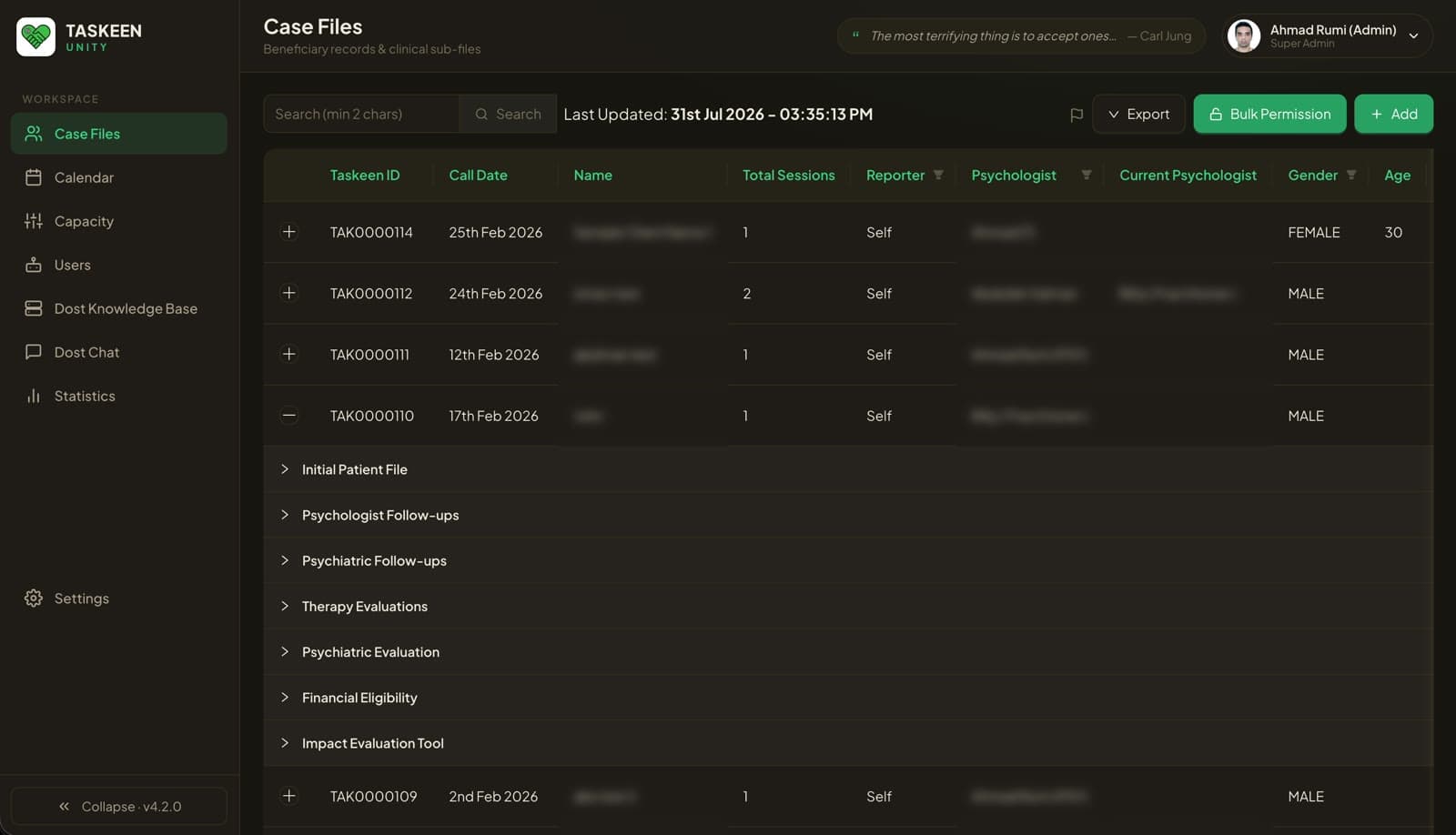
ONE CASE, ALL SEVEN SUB-FILE TYPES 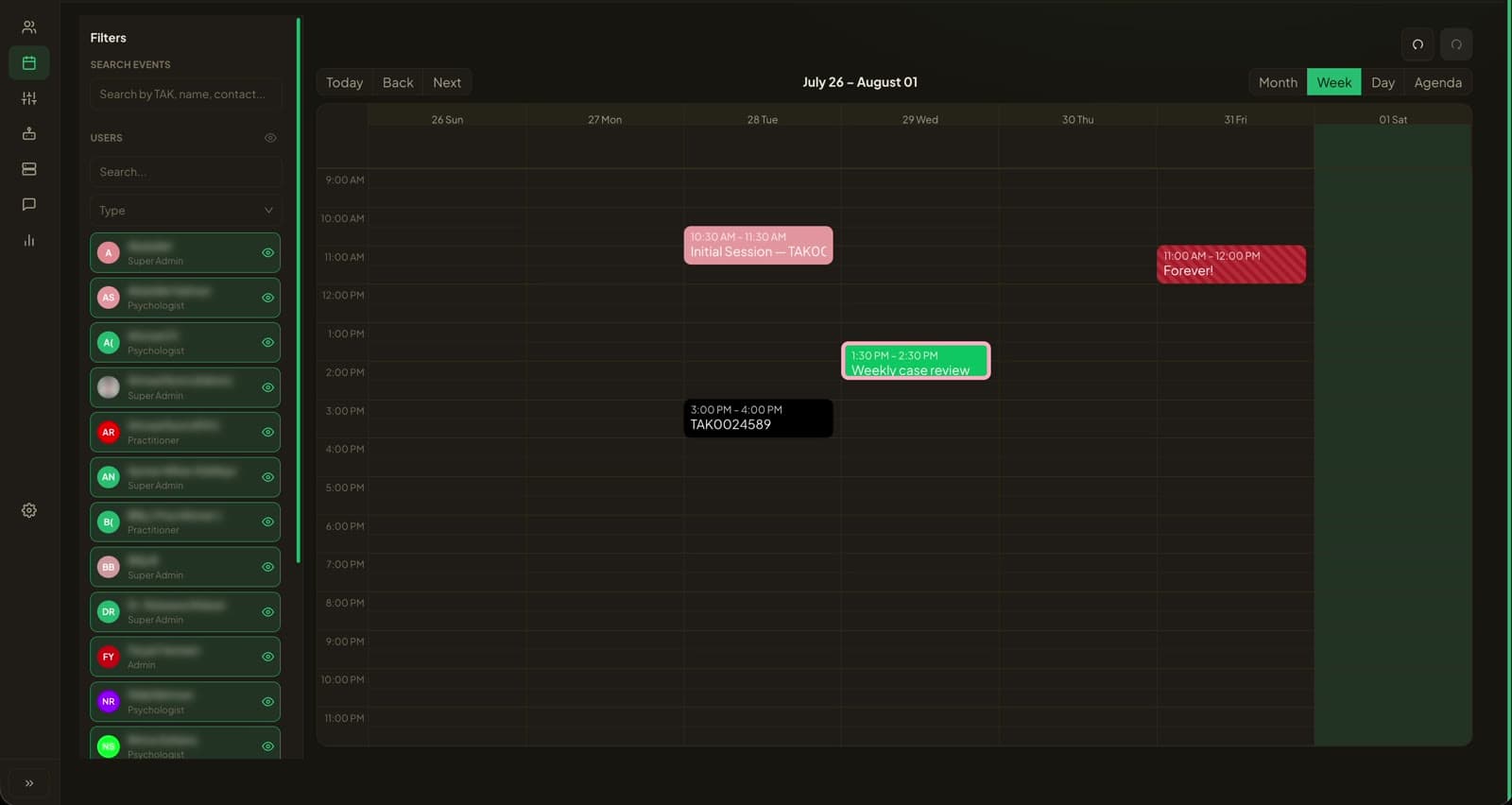
WEEK VIEW — SESSIONS COLOUR-CODED BY TYPE 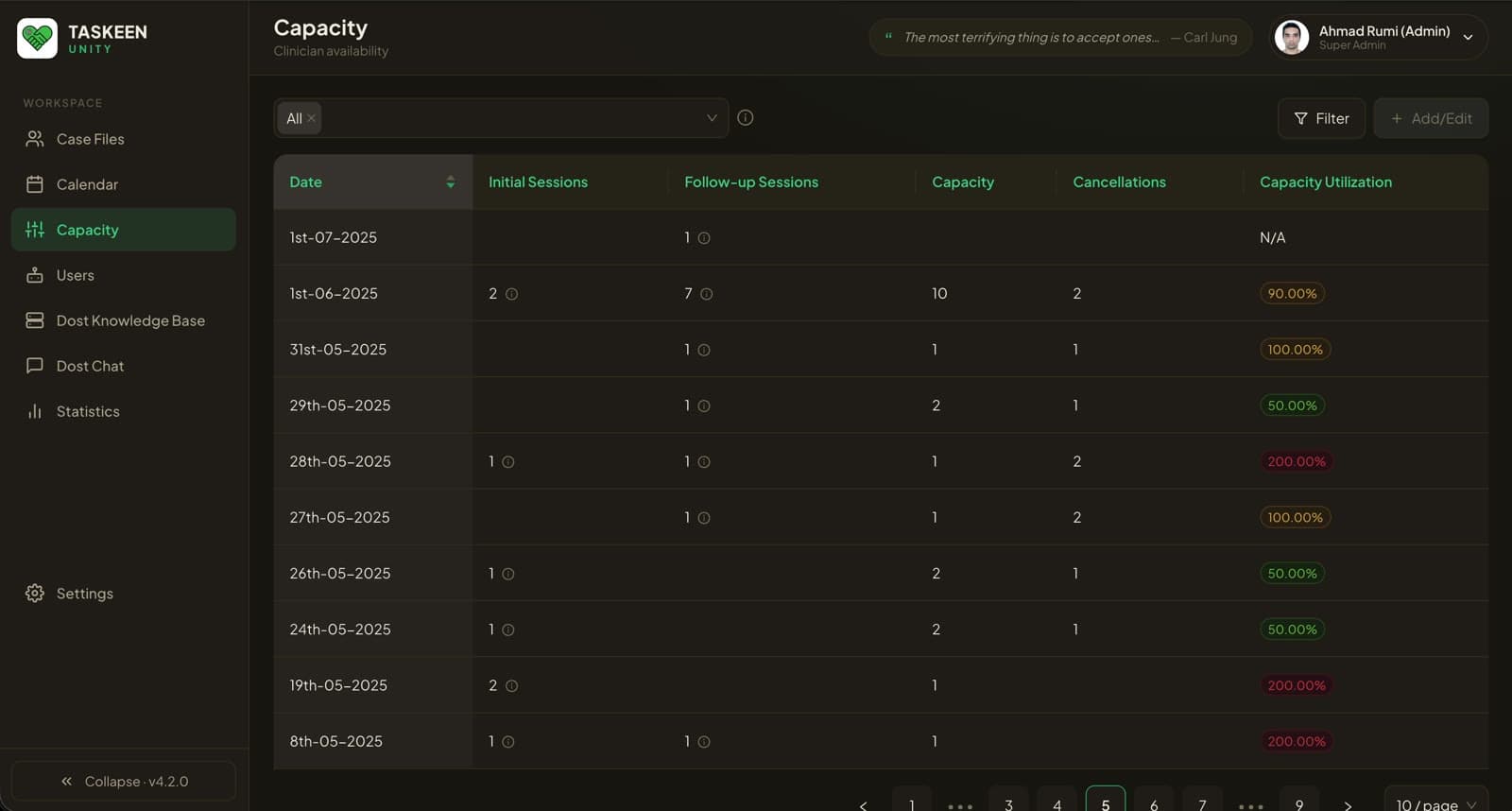
AVAILABILITY — INITIAL AND FOLLOW-UP APART 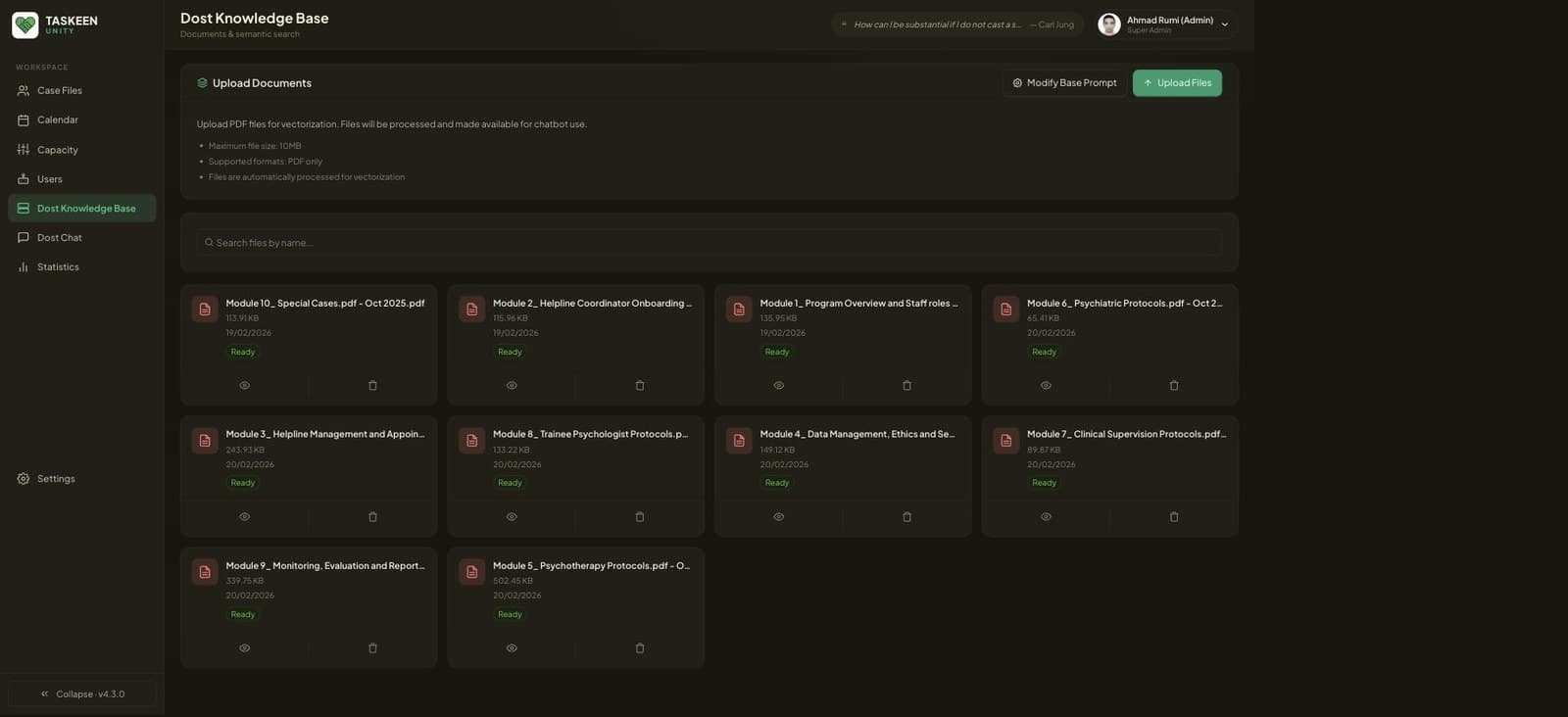
KNOWLEDGE BASE — THE OPERATING MANUAL, VECTORISED 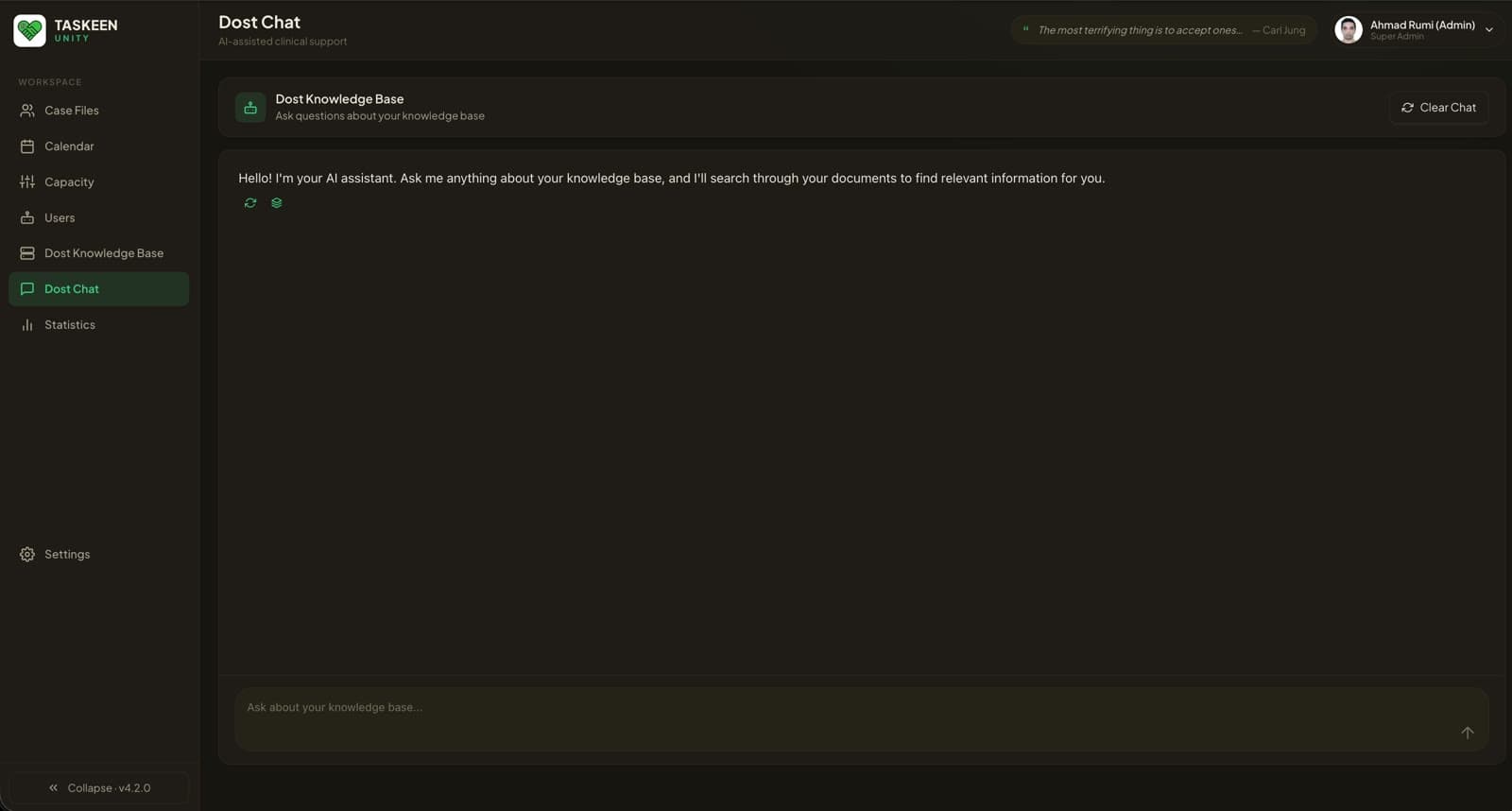
DOST — RETRIEVAL OVER THE PROTOCOL CORPUS 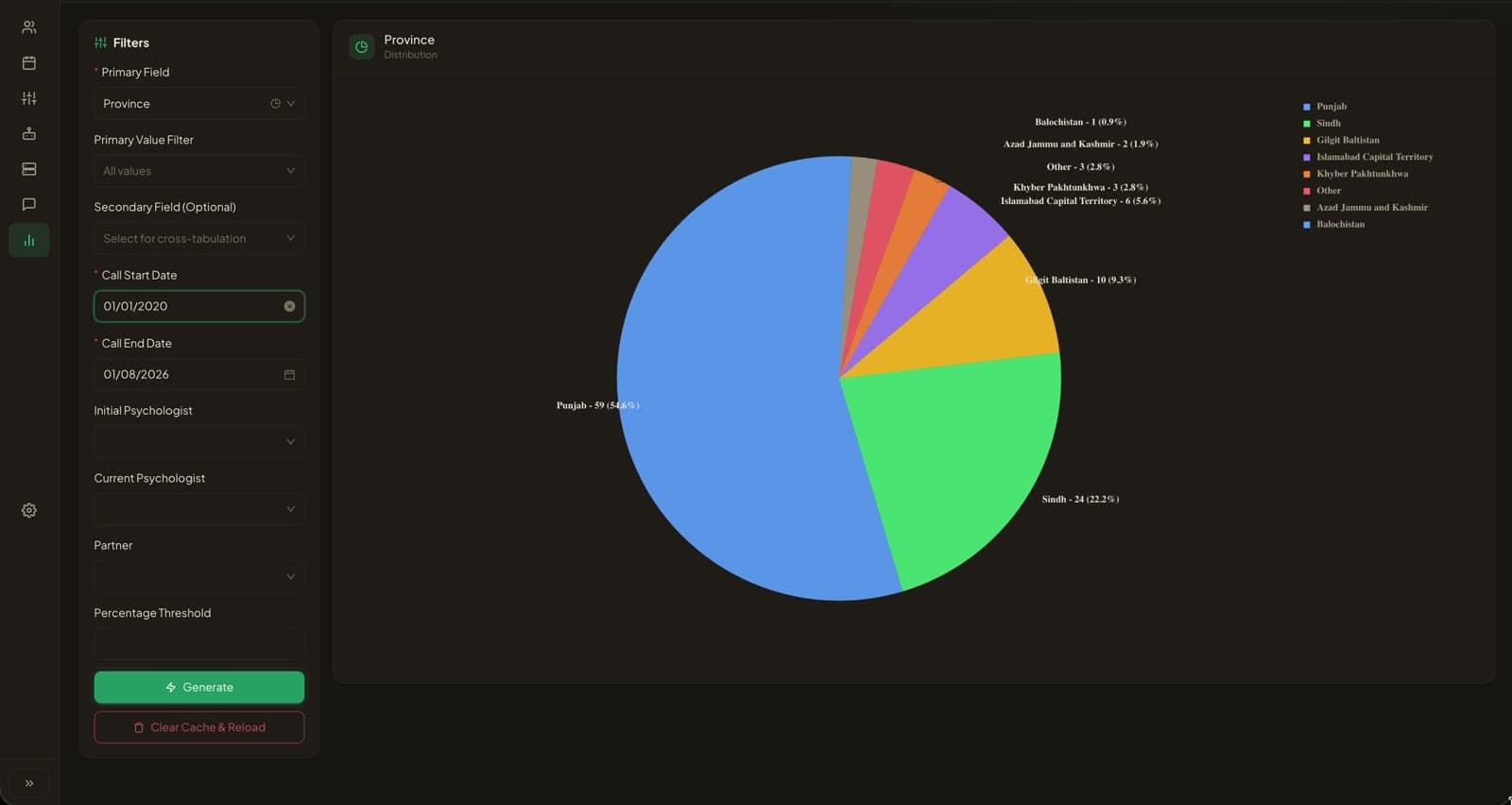
A DISTRIBUTION, BUILT ON DEMAND · DEV ENVIRONMENT